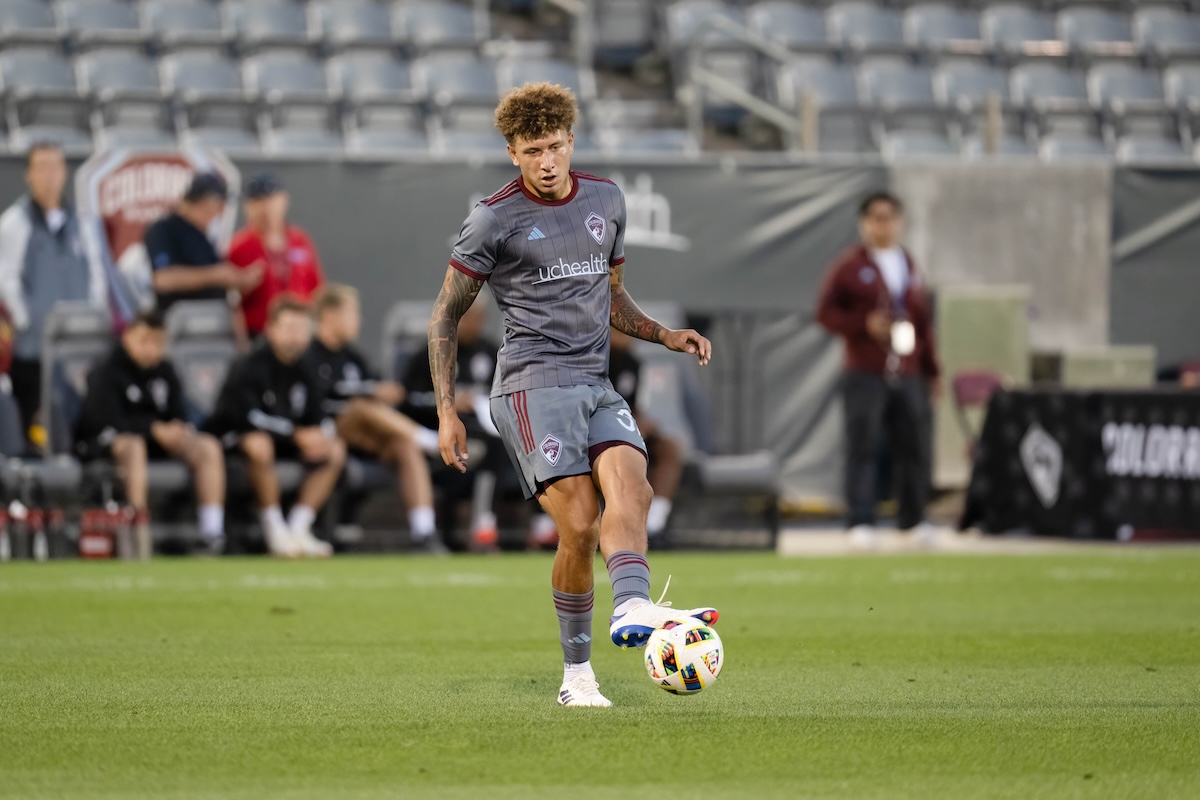
Editorial – Eight different Colorado Rapids and Rapids 2 players have been loaned to the USL teams in 2025. After iterating on Individual Development Plans (IDPs) at the academy and MLS NEXT Pro levels, Colorado has figured out how they want to use the entire American Soccer pyramid to their benefit.
“The more we put talent into our system, the better we have to be at managing that,” Director of Player Personnel Brian Crookham told Burgundy Wave. “We want to be very good in the player development space, getting player movement right. There’s opportunity that has to come for everyone that we’re trying to develop. The movement piece is massive for us being successful.”
Colorado is still all in on the MLS SuperDraft. They drafted nine players last December. With a track record of Cole Bassett, Sam Vines, and Oli Larraz, they believe in their development academy. Get the pathways to the first team and player development right is critical to their model as a club.
Customizing Player Development at Scale:
How do you optimize the player’s development and results on the field? And how do you do that with so many kids needing minutes? A bluechip prospect providing depth on the first team bench and being an unused sub for 20 games helps nobody.
“We can tailor it to each player. But when we hit critical mass, having deep talent in the deeper part of our roster. That’s where the external piece becomes important. You end up playing traffic cop a lot. Everyone’s getting everything they need to the best of our ability, but to help the first team win on Saturday too,” said Crookham.
In the macro, the club wants to develop players at every level. At the individual level, it’s about customizing the IDP and the situation to the player. Some academy kids need to play up a level to be challenged. Some first team youngsters can develop training with the first team but only getting 500 minutes a season. Some guys might need a change of scenery or a coach with fresh eyes, so they get a loan. Maybe a short term call up to the MLS team is well timed, like with Anderson Rosa or Sydney Wathuta.
The club has weekly personnel meetings with first team and second team staff, among others. They figure out who’s training and playing where come the weekend. There is also a monthly loan meeting to check in on players who aren’t in the Rapids bubble.
Academy Technical Director Chris Cartlidge has iterated the heck out of this system. Structure has been needed, especially this past weekend. There was a strange scenario where Rapids 2 played on Saturday afternoon, before the first team that night. Most NEXT Pro games are on the Sunday.
“It works against the second team a little bit. It has the reverse affect of what it normally does. We can usually see after the (MLS) game, who needs the minutes and they can go and play (for R2),” first team head coach Chris Armas said Saturday night.
The club has built a system around managing and tracking player development that has worked at scale. The IDPs are a big part of that. For the loan players, they have weekly calls with a staff member by position to track their progress and given feedback. Drew Moor is assigned to Nate Jones, who’s with Las Vegas Lights of the USL Championship for example. Goalkeeper coach Chris Sharpe was doing video with Adam Beaudry midweek when he was with Colorado Springs Switchbacks recently. The staff then make weekly loan updates available to the club. That informs the monthly loan meeting.
Sydney Wathuta claps the fans as an unused substitute for the Rapids first team in Leagues Cup. He has benefited from the short term call ups and his custom IDP. Photo Credit: Spencer Baldwin
It’s a Crockpot, not a Microwave:
Rapids fans have had fun with ‘Let Pádraig Cook’ memes during the transfer windows. The club has adopted their own analogy for player development.
“This stuff’s happening in a crockpot, not a microwave. When do we add them, how much do we add. Add the heat, back off the heat. The overall philosophy starts with that. Each player has a different option depending on their contract. We have a lot of experience and a good understanding of what we can and can’t get in USL,” Crookham explained.
Crookham was the General Manager of Switchbacks when they were the USL affiliate for the Rapids. He and the club have an understanding of the league. They’ve also got a rolodex of contacts to make moves happen.
Let Padraig Cook! Personally I don’t wanna see Kaye go but ultimately I have faith. I mean at least we are hearing some Rapids rumors! #Rapids96pic.twitter.com/rb4SeVoUAU
Credit should go to the USL as well. Loans from MLS have become a good roster building mechanism. They’ve built out their front offices and scouting networks. More Championship and League One clubs have Technical/Sporting Directors, so coaches aren’t doing first team training and roster moves as much. USL teams also have financial incentives with these moves.
“Most of the deals nowadays, we are getting salary relief for players in USL. We are getting some portion or all of their salary reimbursed. It used to be pretty straightforward: If you’re getting a guy from MLS, we’re (the MLS team) picking up the bill,” Crookham elaborated.
There is way less desperation from either side in these deals. MLS sees the USL, especially the Championship, as a useful tool at a level above NEXT Pro. The USL values having young talented player to balance out their rosters. There’s way less calling on deadline day looking for a home for players. They know their roster and roster needs and have a better understanding of what clubs in the other league have and need.
“There’s a lot of stuff out there about what teams are looking for because we’ve been proactive, they’ve been proactive. It can come from an agent too,” said Crookham.
These moves have had a better hit rate. It’s worked out for all parties. Oh how far we’ve come from the USL affiliate dates where MLS teams would send 5 supplemental roster players on a Friday to train one day then be on the bench Saturday.
Long Term Planning and Roster Build:
The other factor is the players’ contract situations. What’s their on-ramp to the next level look like? What’s the timeline relative to when the club has to make a decision on their contract? How does the club make a decision on Nate Jones’ option for 2026 given he’s been on loan all year? They would have to make a decision on that option before preseason in January.
The club has also started signing academy players to what are effectively pre-Homegrown contracts. Grant Gillmore and Zackory Campagnolo have both signed Rapids 2 contracts that will turn into MLS contracts at a predetermined future date. The club is confident in them and how the R2 program can develop them. So much so, they know when they want them to join the first team.
Talk about betting on the player, the system, and understanding the timeline.
“This adds to the on-ramp for these guys. Gives a measured (less pressured) approach. (Rapids 2) allows us to have a lot of confidence in a long term approach for a player who’s 16, 17,” said Crookham.
The next Cole Bassett or Moïse Bombito is already a Colorado Rapids player. You haven’t heard of him, but Crookham’s got a binder full of info on the kid. Just need to let the crockpot do its thing.
For completeness, here’s the list of all the loan this season:
Nate Jones – Las Vegas Lights FC
Michael Edwards – Charleston Battery
Bryce Jamison – Orange County SC
Adam Beaudry – Colorado Springs Switchbacks
Kimani Stewart-Baynes – Lexington SC
Jackson Travis – Birmingham Legion
Malik Pinto (Rapids 2) – Orange County SC
Joshua Belluz (Rapids 2) – Hartford Athletic
Thank you for reading Burgundy Wave. Support us via our Patreon starting at $5/month. We’re always looking for new talent. Let us know if you’re interested in covering Colorado Soccer.
{"id":"299","mode":"form","open_style":"in_place","currency_code":"USD","currency_symbol":"$","currency_type":"decimal","blank_flag_url":"https:\/\/burgundywave.com\/wp-content\/plugins\/tip-jar-wp\/\/assets\/images\/flags\/blank.gif","flag_sprite_url":"https:\/\/burgundywave.com\/wp-content\/plugins\/tip-jar-wp\/\/assets\/images\/flags\/flags.png","default_amount":5,"top_media_type":"none","featured_image_url":false,"featured_embed":"","header_media":null,"file_download_attachment_data":null,"recurring_options_enabled":true,"recurring_options":{"never":{"selected":true,"after_output":"One time only"},"weekly":{"selected":false,"after_output":"Every week"},"monthly":{"selected":false,"after_output":"Every month"},"yearly":{"selected":false,"after_output":"Every year"}},"strings":{"current_user_email":"","current_user_name":"","link_text":"Leave a tip","complete_payment_button_error_text":"Check info and try again","payment_verb":"Pay","payment_request_label":"Burgundy Wave","form_has_an_error":"Please check and fix the errors above","general_server_error":"Something isn't working right at the moment. Please try again.","form_title":"Burgundy Wave","form_subtitle":"Colorado Soccer content.","currency_search_text":"Country or Currency here","other_payment_option":"Other payment option","manage_payments_button_text":"Manage your payments","thank_you_message":"Thank you for supporting independent coverage of soccer in Colorado.","payment_confirmation_title":"Burgundy Wave","receipt_title":"Your Receipt","print_receipt":"Print Receipt","email_receipt":"Email Receipt","email_receipt_sending":"Sending receipt...","email_receipt_success":"Email receipt successfully sent","email_receipt_failed":"Email receipt failed to send. Please try again.","receipt_payee":"Paid to","receipt_statement_descriptor":"This will show up on your statement as","receipt_date":"Date","receipt_transaction_id":"Transaction ID","receipt_transaction_amount":"Amount","refund_payer":"Refund from","login":"Log in to manage your payments","manage_payments":"Manage Payments","transactions_title":"Your Transactions","transaction_title":"Transaction Receipt","transaction_period":"Plan Period","arrangements_title":"Your Plans","arrangement_title":"Manage Plan","arrangement_details":"Plan Details","arrangement_id_title":"Plan ID","arrangement_payment_method_title":"Payment Method","arrangement_amount_title":"Plan Amount","arrangement_renewal_title":"Next renewal date","arrangement_action_cancel":"Cancel Plan","arrangement_action_cant_cancel":"Cancelling is currently not available.","arrangement_action_cancel_double":"Are you sure you'd like to cancel?","arrangement_cancelling":"Cancelling Plan...","arrangement_cancelled":"Plan Cancelled","arrangement_failed_to_cancel":"Failed to cancel plan","back_to_plans":"\u2190 Back to Plans","update_payment_method_verb":"Update","sca_auth_description":"Your have a pending renewal payment which requires authorization.","sca_auth_verb":"Authorize renewal payment","sca_authing_verb":"Authorizing payment","sca_authed_verb":"Payment successfully authorized!","sca_auth_failed":"Unable to authorize! Please try again.","login_button_text":"Log in","login_form_has_an_error":"Please check and fix the errors above","uppercase_search":"Search","lowercase_search":"search","uppercase_page":"Page","lowercase_page":"page","uppercase_items":"Items","lowercase_items":"items","uppercase_per":"Per","lowercase_per":"per","uppercase_of":"Of","lowercase_of":"of","back":"Back to plans","zip_code_placeholder":"Zip\/Postal Code","download_file_button_text":"Download File","input_field_instructions":{"tip_amount":{"placeholder_text":"How much would you like to tip?","initial":{"instruction_type":"normal","instruction_message":"How much would you like to tip? Choose any currency."},"empty":{"instruction_type":"error","instruction_message":"How much would you like to tip? Choose any currency."},"invalid_curency":{"instruction_type":"error","instruction_message":"Please choose a valid currency."}},"recurring":{"placeholder_text":"Recurring","initial":{"instruction_type":"normal","instruction_message":"How often would you like to give this?"},"success":{"instruction_type":"success","instruction_message":"How often would you like to give this?"},"empty":{"instruction_type":"error","instruction_message":"How often would you like to give this?"}},"name":{"placeholder_text":"Name on Credit Card","initial":{"instruction_type":"normal","instruction_message":"Enter the name on your card."},"success":{"instruction_type":"success","instruction_message":"Enter the name on your card."},"empty":{"instruction_type":"error","instruction_message":"Please enter the name on your card."}},"privacy_policy":{"terms_title":"Terms and conditions","terms_body":null,"terms_show_text":"View Terms","terms_hide_text":"Hide Terms","initial":{"instruction_type":"normal","instruction_message":"I agree to the terms."},"unchecked":{"instruction_type":"error","instruction_message":"Please agree to the terms."},"checked":{"instruction_type":"success","instruction_message":"I agree to the terms."}},"email":{"placeholder_text":"Your email address","initial":{"instruction_type":"normal","instruction_message":"Enter your email address"},"success":{"instruction_type":"success","instruction_message":"Enter your email address"},"blank":{"instruction_type":"error","instruction_message":"Enter your email address"},"not_an_email_address":{"instruction_type":"error","instruction_message":"Make sure you have entered a valid email address"}},"note_with_tip":{"placeholder_text":"Your note here...","initial":{"instruction_type":"normal","instruction_message":"Attach a note to your tip (optional)"},"empty":{"instruction_type":"normal","instruction_message":"Attach a note to your tip (optional)"},"not_empty_initial":{"instruction_type":"normal","instruction_message":"Attach a note to your tip (optional)"},"saving":{"instruction_type":"normal","instruction_message":"Saving note..."},"success":{"instruction_type":"success","instruction_message":"Note successfully saved!"},"error":{"instruction_type":"error","instruction_message":"Unable to save note note at this time. Please try again."}},"email_for_login_code":{"placeholder_text":"Your email address","initial":{"instruction_type":"normal","instruction_message":"Enter your email to log in."},"success":{"instruction_type":"success","instruction_message":"Enter your email to log in."},"blank":{"instruction_type":"error","instruction_message":"Enter your email to log in."},"empty":{"instruction_type":"error","instruction_message":"Enter your email to log in."}},"login_code":{"initial":{"instruction_type":"normal","instruction_message":"Check your email and enter the login code."},"success":{"instruction_type":"success","instruction_message":"Check your email and enter the login code."},"blank":{"instruction_type":"error","instruction_message":"Check your email and enter the login code."},"empty":{"instruction_type":"error","instruction_message":"Check your email and enter the login code."}},"stripe_all_in_one":{"initial":{"instruction_type":"normal","instruction_message":"Enter your credit card details here."},"empty":{"instruction_type":"error","instruction_message":"Enter your credit card details here."},"success":{"instruction_type":"normal","instruction_message":"Enter your credit card details here."},"invalid_number":{"instruction_type":"error","instruction_message":"The card number is not a valid credit card number."},"invalid_expiry_month":{"instruction_type":"error","instruction_message":"The card's expiration month is invalid."},"invalid_expiry_year":{"instruction_type":"error","instruction_message":"The card's expiration year is invalid."},"invalid_cvc":{"instruction_type":"error","instruction_message":"The card's security code is invalid."},"incorrect_number":{"instruction_type":"error","instruction_message":"The card number is incorrect."},"incomplete_number":{"instruction_type":"error","instruction_message":"The card number is incomplete."},"incomplete_cvc":{"instruction_type":"error","instruction_message":"The card's security code is incomplete."},"incomplete_expiry":{"instruction_type":"error","instruction_message":"The card's expiration date is incomplete."},"incomplete_zip":{"instruction_type":"error","instruction_message":"The card's zip code is incomplete."},"expired_card":{"instruction_type":"error","instruction_message":"The card has expired."},"incorrect_cvc":{"instruction_type":"error","instruction_message":"The card's security code is incorrect."},"incorrect_zip":{"instruction_type":"error","instruction_message":"The card's zip code failed validation."},"invalid_expiry_year_past":{"instruction_type":"error","instruction_message":"The card's expiration year is in the past"},"card_declined":{"instruction_type":"error","instruction_message":"The card was declined."},"missing":{"instruction_type":"error","instruction_message":"There is no card on a customer that is being charged."},"processing_error":{"instruction_type":"error","instruction_message":"An error occurred while processing the card."},"invalid_request_error":{"instruction_type":"error","instruction_message":"Unable to process this payment, please try again or use alternative method."},"invalid_sofort_country":{"instruction_type":"error","instruction_message":"The billing country is not accepted by SOFORT. Please try another country."}}}},"fetched_oembed_html":false}


 Eamon Shaw
  Spencer Baldwin