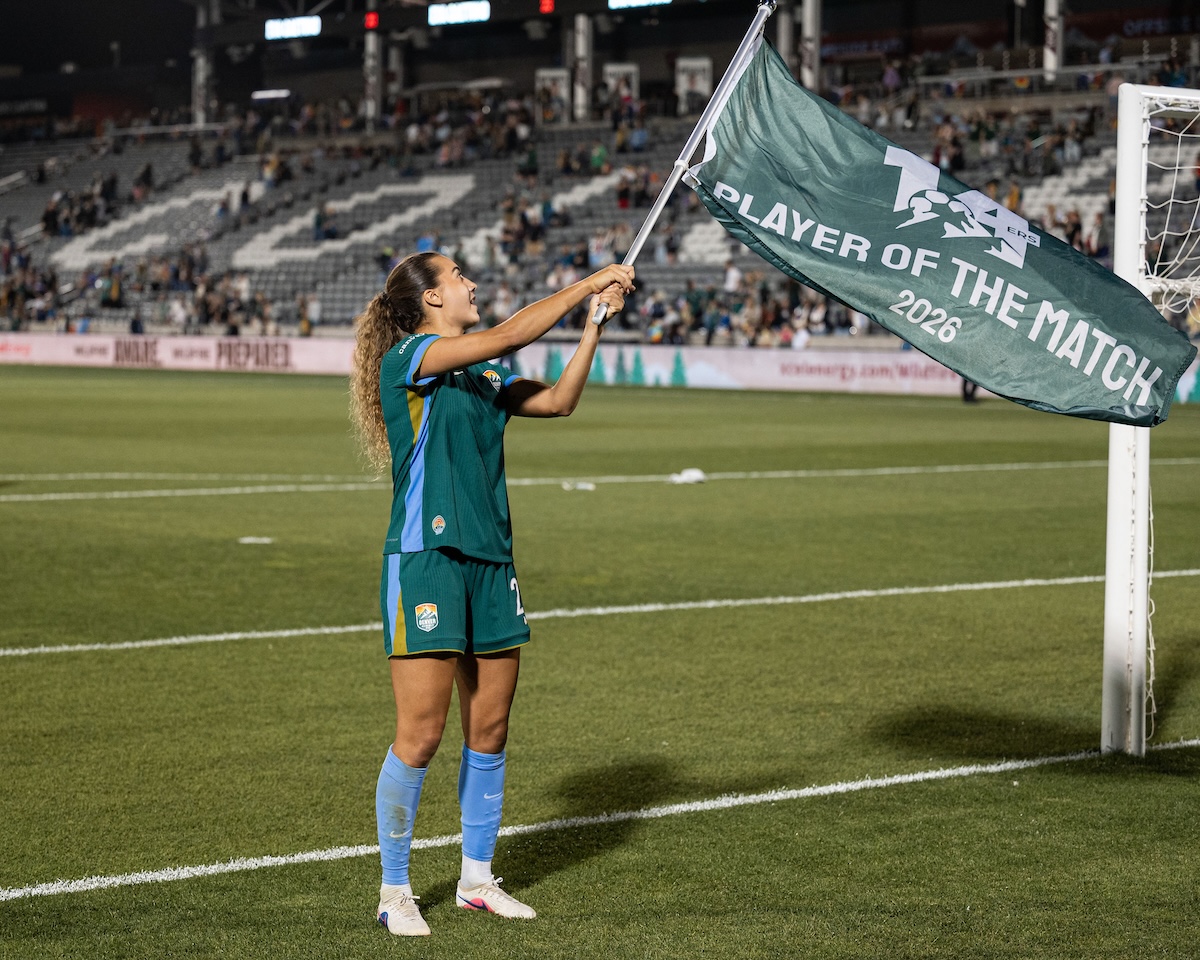
Denver, Colo. – In April, Burgundy Wave profiled the 14ers, the supporters group that grew out of the For Denver FC movement and helped turn Denver Summit FC’s first season into one of the loudest new environments in the NWSL. But supporter culture does not grow in a vacuum. Behind the flags, drums, marches, tailgates, and tifos is a constant back-and-forth between the supporters and the club trying to help that energy scale without taking ownership of it.
That balance is a major part of Sammy Friedrich’s job.
Friedrich serves as Denver Summit FC’s Supporter Services and Street Team Coordinator, making him the direct point of contact between the club’s front office and the 14ers. His role also includes grassroots marketing efforts through the club’s street team, putting him near the intersection of supporter culture, community outreach, and fan engagement.
In practice, that means Friedrich’s day-to-day work is split between two worlds. On one side, he is in regular communication with the 14ers about what they want to bring to matchday. On the other, he is working internally with the club, venue staff, facilities, and event operations to make sure those ideas can actually happen inside a professional sports environment.
That includes everything from tifos, flags, drums, March to the Match logistics, early entry, and venue approvals. Friedrich described the relationship as one that goes both ways: the club helps make sure things are buttoned up from a policy and operations standpoint, while the 14ers continue to push the atmosphere forward from the supporter side.
“It’s a lot of collaboration on what we can do together to help them grow and scale, as well as help create what we see as the best atmosphere in the NWSL,” Friedrich said.
The word Friedrich used to describe the relationship was “symbiotic.” That is an important distinction. The Summit understands that the 14ers are not simply a fan club that appeared after the team began play. Many of the same people who helped create the For Denver movement, the grassroots push to bring professional women’s soccer to Colorado, later redirected that energy into building the club’s first supporters group.
From the front office’s perspective, that history matters.
“The club wouldn’t be here without the For Denver movement, which started with a lot of our 14ers,” Friedrich said. “To a certain degree, we wouldn’t exist without them, and they wouldn’t exist without us.”
That mutual dependence has shaped how the club approaches its role. Friedrich said he is not heavily involved in the creative ideation process for the 14ers. The club does not want to step in and tell supporters what chants to sing, what displays to create, or what the group’s identity should become. Instead, Friedrich sees the club’s role as helping amplify what the 14ers are already trying to do. The question, as he put it, is not how the club can control the group.
It is, “How can we make this bigger, make this better, and really drive home what you guys are trying to do?”
That approach was tested immediately at Denver Summit’s home opener at Empower Field at Mile High. The 14ers’ tifo for the club’s first home match became one of the defining images of the day, but getting it into the stadium and displayed properly required extensive coordination. The match came with a national broadcast, the largest attendance in league history, and a tightly choreographed pregame production that included pyro, fireworks, and limited time to deploy the display.
For Friedrich, that tifo remains one of the strongest examples of what the relationship between the club and supporters can look like when everything comes together. “I think the biggest thing, the thing I always come back to, is the tifo for the home opener at Mile High,” Friedrich said. “That was a very long and very tedious process.”
The payoff was worth it. With more than 63,000 fans in the stadium, the 14ers were able to put their mark on one of the most visible moments in Denver Summit’s young history. For the club, it was proof that the supporter culture surrounding the Summit could translate to the largest stage the team had seen.
“Being able to get that deployed and displayed, and getting 63,000 sets of eyes just in the stadium, not even counting the broadcast as well, it was a surreal day,” Friedrich said. “That was probably my crowning jewel for the day as well, because it was like, ‘Here, we have the best fans in the league.’”
While the tifo at Mile High stands out as the most visible collaboration, Friedrich said the full matchday experience is built from a combination of supporter-led and club-led spaces.

At matches at both Mile High and DICK’S Sporting Goods Park, the 14ers have taken control of the tailgating scene. The club, meanwhile, has focused more on the Fan Zone and club-centric activities. That division has allowed the supporters to create their own pregame culture while the club works to engage casual fans, families, and new supporters who may not yet be connected to the 14ers.
The most encouraging part, according to Friedrich, has been that the 14ers’ tailgates have not only served their own membership. They have also become an entry point for the general fan base. “They’ve done a really great job engaging not just their own membership base, but the general fan base as well at their tailgates,” Friedrich said. “They’ve been humongous every single time.”
That matters for a first-year club still building its habits and traditions. Supporter culture can help establish identity inside the stadium, but it can also help new fans understand how to participate. For Summit, the early challenge has not been creating interest from scratch, it has been keeping up with the enthusiasm already present across Denver and Colorado.
From a supporter services and fan engagement perspective, Friedrich said that buy-in has been one of the biggest surprises of year one.
“What’s really surprised me is just how enthusiastic and bought in everybody in this entire city and state is with the Denver Summit,” Friedrich said.
That local enthusiasm has also shaped how the club thinks about its broader community presence. “Our two community pillars are very grassroots-centric,” Friedrich said. “It’s ensuring equity and access to sport.” In year one, much of that work has focused on building relationships with local nonprofits and putting on free clinics for kids in underserved areas.
For a club still in its first season, that work is part of building a playbook. The Summit are establishing what their matchday experience looks like, how they want to show up in the community, and how they can become part of Colorado’s larger soccer landscape.
That landscape already has a deep connection to the women’s game. Colorado has produced a number of high-level women’s players, and Friedrich described the state as a “sleeper powerhouse” in women’s soccer. What the Summit provides now is a visible professional team at the top of that local pathway.
“I think it can’t not have an impact,” Friedrich said. “Having something at the pinnacle in your own backyard is only going to create a more tangible goal for a lot of the kids, boys and girls, in Colorado.”
That impact may take years to fully measure, but the early signs around the club suggest that Summit’s presence is already changing what women’s sports can look like in Denver. In a city and state with no shortage of professional men’s teams, the arrival of a professional women’s club gives young girls something different: a team they can see themselves in, support in person, and point to as a real example of where the game can take them.
The club is also navigating an unusual first-year venue situation. Summit opened their home campaign at Mile High, has played matches at DICK’S Sporting Goods Park, and is still working toward its temporary stadium solution. Centennial Stadium is due to open later this month. They will play at least two more home games in Commerce City before then.
For supporters, changing venues creates challenges around section size, tifo dimensions, tailgate logistics, and gameday routines.
Still, the foundation has already been set. When asked what success would look like at the end of year one from a supporter culture and fan engagement standpoint, Friedrich did not point to a complete reinvention. Instead, he pointed to continuity. The first few matches have created a baseline. Now, the goal is to maintain that level of energy through a crowded late-summer and fall schedule. “Matches one, two, and three have created that foundation, that baseline, for what the best party in the NWSL looks like,” Friedrich said.
Long term, Friedrich wants to see the supporter section continue to grow in both size and expression. That means more flags, more drums, more members, more renewals, and a bigger atmosphere as the 14ers continue to establish themselves. He emphasized that no one expected a fully mature supporter section from the first match. The important thing is that the base has been built. “It was never going to be a million flags and a million drums in the section from the first week, but we’ve already set such a great foundation for it,” Friedrich said.

The club’s job now is to help that foundation become sustainable. Denver Summit FC and the 14ers are still early in their relationship. The club is new. The supporters group is new. The venues are changing. The traditions are still being written. But the early returns have already made Denver one of the more interesting supporter environments in the NWSL.
If the 14ers’ first year has been about proving that Denver was ready to show up for professional women’s soccer, the club’s role is about helping that energy grow without dulling what made it powerful in the first place.
For Friedrich, the ceiling is not just having one of the loudest supporter sections in the league. It is becoming a model for what supporter culture in the NWSL can be. “If we keep doing what we’re doing, we become the blueprint for supporter groups in the NWSL,” Friedrich said.
Thank you for reading Burgundy Wave. Support us via our Patreon starting at $5/month. You can also make a one-time contribution via Tip Jar. We’re always looking for new talent. Let us know if you’re interested in covering Colorado Soccer.
 Matt Pollard
  Eamon Shaw