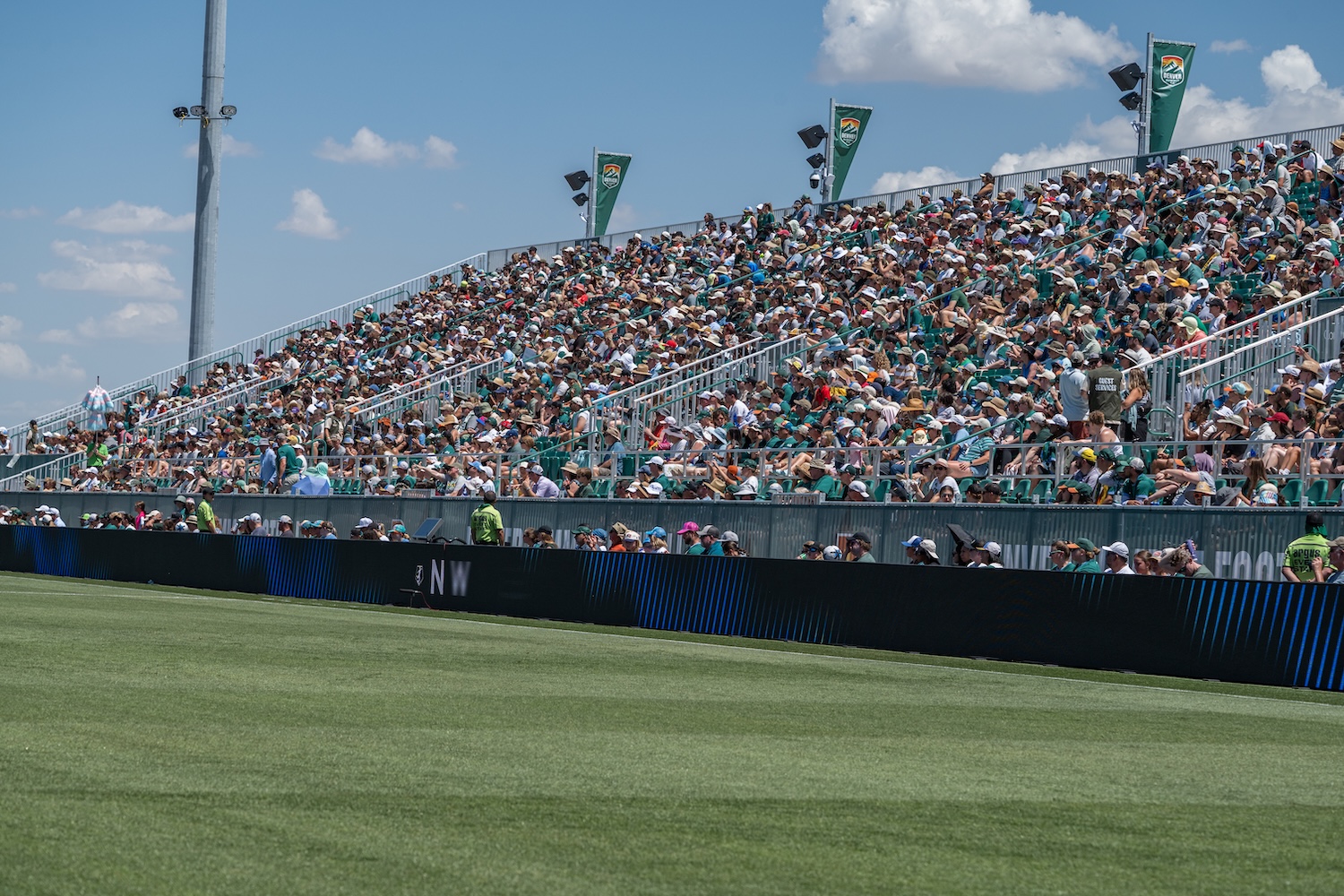
Centennial, Colo. – For most of its history, the NWSL has had a stadium problem: Teams needed places to play, and they often had to fit into whatever was available. That meant college fields, school-district stadiums, soccer complexes, municipal venues and existing MLS venues. Shared buildings that were not really built around women’s soccer.
That is changing. Slowly, and unevenly, but surely. Before the NWSL, the United States had already seen two women’s professional soccer leagues come and go. The WUSA kicked off in 2001 and lasted three seasons. WPS started in 2009 and also lasted three seasons before shutting down. By the time the NWSL arrived in 2013, the question was not just whether people cared about Women’s Soccer. It was whether a league could stick around long enough to become part of the sports landscape.
The league is not just growing because more people are watching. It is growing because clubs are starting to look and feel more permanent. Infrastructure plays a big part. Stadiums are one of the easiest ways to see that shift.

Phase I: Just getting on the field
In 2013, the league’s first season, the stadium picture looked very different from today. Half of the league played in either college venues or local soccer complexes. Others were scattered across municipal fields, school-district stadiums, and lower-division soccer venues. Portland was the standout because the Thorns were already sharing Providence Park with the Timbers. That was not the norm.
That early setup made sense. The league was new. Previous leagues had folded quickly. The goal was not to build a perfect stadium model right away. The goal was to survive.
Phase II: Borrowing infrastructure
By the league’s tenth season, the picture had changed. More clubs were playing in MLS stadiums or bigger professional venues. Angel City launched at BMO Stadium in Los Angeles. Seattle Reign, named OL Reign at the time, moved into Lumen Field. Washington began moving toward Audi Field. San Diego went from Torero Stadium to Snapdragon Stadium. Kansas City moved into Children’s Mercy Park before later opening its own stadium.
This was a big step. The product looked more professional. Better stadiums meant better sightlines, better broadcasts, better press areas, better fan experience, better sponsorship opportunities, and a stronger sense that these clubs belonged in the same sports conversation as other pro teams.
But the stadium move alone did not magically fix everything. Some teams saw big attendance growth after moving into better venues. Others did not. That is where the story gets more interesting.
Better stadiums help, but they are not magic:
Looking at attendance before and after venue moves, there is no one-size-fits-all answer. San Diego moving into Snapdragon Stadium helped unlock a much bigger crowd. Washington becoming a full-time resident of Audi Field, giving Spirit a more stable and visible home. Seattle moving back into Lumen Field helped the Reign feel more connected to the city again.
There are cautionary examples too. Orlando moved into a better soccer stadium and still saw attendance fall from its first-year high. Chicago moved and did not immediately get a boost. Those cases matter because they show that a stadium is not enough by itself. Winning helps. Location matters. Ownership matters. Marketing matters. Most of all, the club has to give fans a reason to build the habit of showing up.
The real question is control:
Kansas City is another strong example of how a venue change can be beneficial for a club, but in two steps. Moving into Children’s Mercy Park helped the Current, but opening CPKC Stadium gave them something even more valuable: a building centered on them.
When a team owns or controls its stadium, it can do more than sell tickets. It can shape the entire matchday experience, build premium seating areas, sell naming rights and sponsorship space, control more of the food, drink, and event revenue, and make the building feel unmistakably tied to the club. That is a major difference from renting space in a stadium built for another team.
That is why CPKC Stadium matters even though it’s a smaller venue than CMP. The Current were already drawing well. The bigger change was that their home games became a stronger business engine. Each match could now generate more value, give sponsors more reason to invest, and give fans a place that felt permanent. Kansas City did not just get a stadium. They got a foundation. A home of their own.
In the league’s early years, the stadium question was mostly about survival: Where can we play our games? That meant sharing spaces. Those venues gave the league a place to exist, but they offered very little control over how a club looked or felt on matchday. Moving into MLS stadiums and larger professional venues was an obvious step forward. The facilities were better, the fan experience improved, and the league felt more legitimate. But even then, many NWSL clubs were still building their identity inside someone else’s home. The host venue often controlled the look of the building, the vendors, the sponsorship space, and the limits of what fans could do. NFL stadiums and major-event venues can offer huge visibility, but they raise the same question: How much of the environment actually belongs to the women’s club?
That is the larger shift Kansas City represents. CPKC Stadium is not just a venue to play soccer. It is a signal that women’s soccer can be the main event, not an add-on.
Denver Summit is part of the next chapter:
In some ways, Denver Summit FC’s launch echoes the early years of the NWSL itself: temporary homes, shared spaces, and a new women’s soccer project trying to prove it can become something permanent. But the long-term plan at Santa Fe Yards is what makes Denver’s situation feel bigger than a normal expansion launch. That is what makes this moment feel different from the earlier eras of women’s pro soccer in the United States. For a long time, the question was whether a league could survive at all. Now, in places like Denver, the question is what kind of roots a club can put down.
A permanent stadium district would give the Summit something many women’s teams have spent years trying to find: permanence. Not just a schedule. Not just a logo. Not just a place to play for now. A home.
That matters in Denver. This is a city with no shortage of men’s professional teams, but the Summit have a chance to build something different. A stadium centered around a women’s soccer club would give young girls, local players, supporters, and soccer families a place where women’s sports are not treated as an add-on. They are the reason the place exists.
That is the real promise of Santa Fe Yards. The stadium itself is only part of it. The bigger question is whether it can become a gathering place: somewhere fans build routines, supporters create traditions, kids come back game after game, and the club starts to feel woven into the city. If that happens, Denver would not just have an NWSL team. It would have a women’s soccer home.
Thank you for reading Burgundy Wave. Support us via our Patreon starting at $5/month. You can also make a one-time contribution via Tip Jar. We’re always looking for new talent. Let us know if you’re interested in covering Colorado Soccer.
 Matt Pollard
  Eamon Shaw