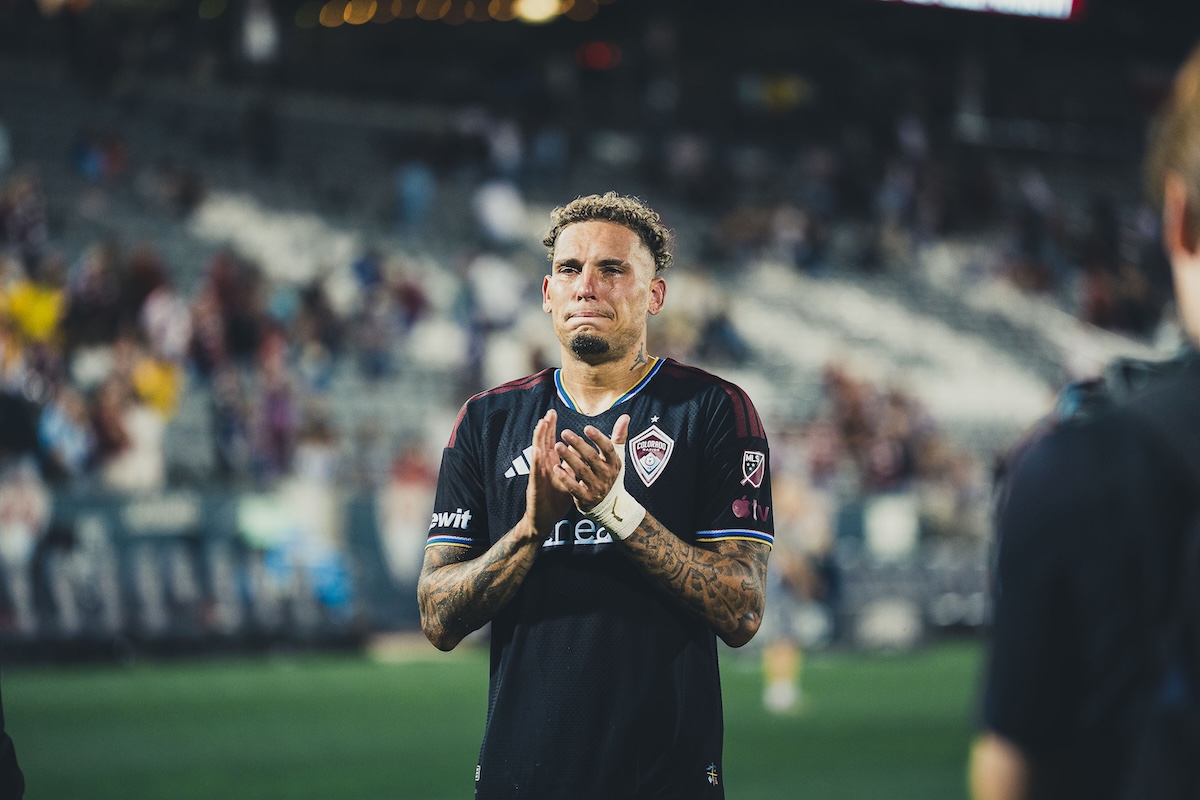
Editorial – Selling your leading scorer in September, with the playoffs in sight, is the kind of move that gets a front office second-guessed for years. Colorado Rapids did it anyway. Did the club get it right? How much are the final games of 2026 a fair way to judge this window?
That is not a popular view after two straight 1-1 draws. Head Coach Matt Wells’ side are straddling the playoff line in the Western Conference. But the case for this summer was never really about October.
Twelve Million Reasons To Say Yes
Start with the number. On September 2, Colorado sent Rafael Navarro to St. Louis CITY SC for $12 million in cash, rising to $12.25 million with add-ons, plus a sell-on percentage. No MLS club had ever paid another more for a player.
Navarro earned every dollar of that valuation: 38 goals in 97 league matches, 10 of them this year. Still, as Burgundy Wave pointed out when the Navarro trade became official, it was only the second-biggest sale in club history, behind Lucas Herrington’s move to Hull City weeks earlier this summer.
Here is what matters most: the money went straight back into the squad. Morgan Whittaker arrived from Middlesbrough for a club-record $10.7 million, with Ibrahim Sadiq and Sayed Abu Farkhi alongside him. A club that sells and pockets the cash deserves criticism. This one sold and spent.
| Player | Direction | Detail |
| Rafael Navarro | Out, to St. Louis CITY SC | $12M cash trade, an MLS record |
| Lucas Herrington | Out, to Hull City | Largest sale in club history |
| Morgan Whittaker | In, from Middlesbrough | Club-record $10.7M, Designated Player |
| Ibrahim Sadiq | In, from AZ Alkmaar | Ghanaian winger |
| Sayed Abu Farkhi | In, in from Maccabi Tel Aviv | Israel international U22 forward |
Club president Pádraig Smith said the plan was to “shape the roster around Matt [Wells’] game model.” Front offices say things like that all the time. This one actually acted on it.
Control Without Punch Was Never Going To Be Enough
The uncomfortable truth is that the Navarro-era attack was not working as a unit. Before the September 9 trip to Austin, the Burgundy Boys sat in the top five in average possession and had allowed the seventh-fewest expected goals in the league.
They also ranked 29th in shots on target per match. One striker scoring 10 goals was covering for a side that kept the ball beautifully and then did very little with it. The system wasn’t working for a number of reasons. Was Navarro a great square peg in a round hole? Smith and Wells have hinted yes.
The New Front Line Needs Time, Not Verdicts
Whittaker and Sadiq give Wells wide players who attack the box, which is precisely what was missing. Judging them now is unfair. Wells himself said the squad was short on its top line in Austin while signings waited on visa clearance.
Paxten Aaronson is the piece to build around. He started with Whittaker and Darren Yapi in the Open Cup semifinal, and that trio is the real project here, not the next result.
What The Numbers Are Really Saying
This team is fascinating to analyze because the profile is so clear. A side that keeps the ball, limits chances, and rarely tests the goalkeeper will play tight, low-event matches more often than not.
Odds analysts spot that kind of pattern quickly. Soccer markets reward preparation and discipline, and guides such as MyTopSportsbooks explain how moneylines and totals work, which shows why a possession-heavy side can be rated one way on goals and another on results.
The trend has shifted lately, though. Four of the last five league matches ended level, including a 3-3 thriller with Seattle. That looks like a team learning to take risks, with all the mess that comes with it.
The Home-And-Away Problem Is The Real Story
The real cause for concern is not the transfer window but the map. Last year’s side went 8-5-4 in Commerce City and 3-10-4 away, then missed the playoffs by a single point after a 90th-minute LAFC goal on Decision Day.
That contrast has not gone away. No signing fixes it alone. It is a mentality and structure issue, and it is the one area where Wells has yet to convince. Wells has argued the underlying issue isn’t home vs away but rather then team’s reaction to leading vs trailing. Colorado has yet to get a result when conceding first. They have scored first in four straight games with no wins.
The Cup Run Showed Both Sides
The U.S. Open Cup was the best argument for this group: a 1-0 win over Union Omaha, a penalty shootout escape against Colorado Springs Switchbacks, and a composed 2-0 quarterfinal against San Jose.
It was also the harshest reality check. The 3-0 semifinal loss to St. Louis on home turf showed exactly how far there is to go against the conference’s form team.
Six Matches, One Honest Expectation
Colorado is 11-13-5, with 38 points from 29 matches and a goal difference of zero. That is three points behind seventh-place Seattle and one behind the LA Galaxy in eight. Here is what remains:
- October 17: Portland Timbers, away
- October 24: Vancouver Whitecaps, home
- October 28: San Jose Earthquakes, away
- October 31: Chicago Fire, home
- November 7: FC Dallas, away
The honest read is that eight is a stretch and the Wild Card places are the realistic target. Minnesota and Chicago at home are must-wins. Anything from Portland, San Jose, or Dallas on the road would be a bonus given the away record.
The Verdict
A zero goal difference after 29 matches says this is an average team, and average teams do not turn down record offers. They use them to stop being average.
So judge this summer next spring, when Whittaker has had a preseason and Wells has had a full winter with his squad. If the Rapids sneak into the postseason first, call it a head start.
Thank you for reading Burgundy Wave. Support us via our Patreon starting at $5/month. You can also make a one-time contribution via Tip Jar. You can email us at burgundywavemedia@gmail.com. We’re always looking for new talent. Let us know if you’re interested in covering Colorado Soccer.
 Eamon Shaw
  Matt Pollard